

Found this problem in a Facebook group. It is likely a homework problem from an undergraduate computer science class.
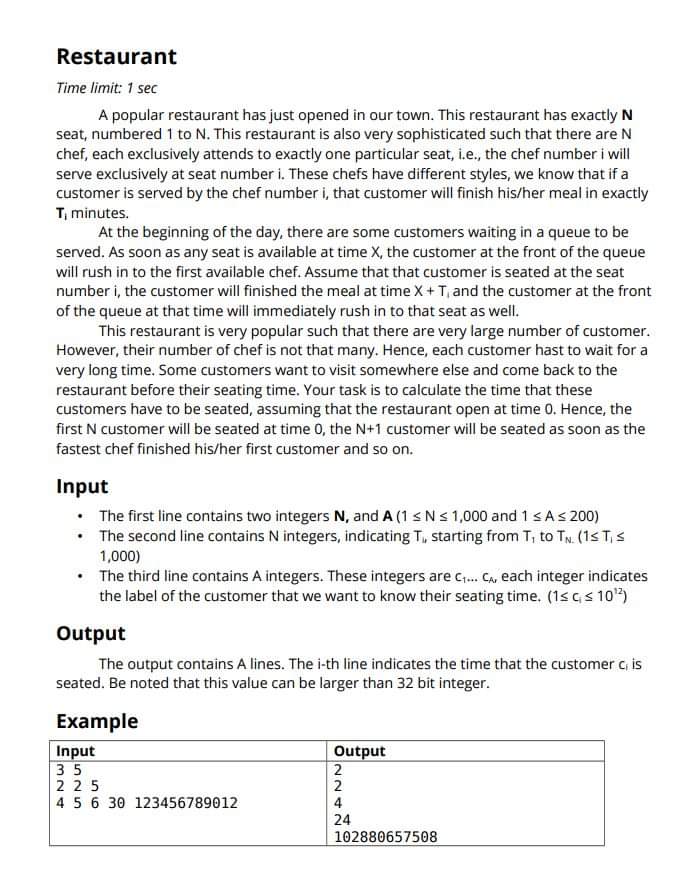
Solution: Python 3.10
import math

chef = [2,2,5]
customer = [4,5,6,30,123456789012]

lcm_C = math.lcm(*chef)
fx = []
for i in range(lcm_C // min(chef)):
    for ti in chef:
        nti = i * ti
        if (nti < lcm_C):
            fx.append(nti)
fx.sort()
print(lcm_C)
print(fx)
len_fx = len(fx)
for ci in customer:
    k = (ci-1) // len_fx
    x = (ci-1) % len_fx
    print(f'{ci}: k={k} x={x} ans={k*lcm_C+fx[x]}')
import math
chef = [2,2,5]
customer = [4,5,6,30,123456789012]
lcm_C = math.lcm(*chef)
fx = []
for i in range(lcm_C // min(chef)):
for ti in chef:
nti = i * ti
if (nti < lcm_C):
fx.append(nti)
fx.sort()
print(lcm_C)
print(fx)
len_fx = len(fx)
for ci in customer:
k = (ci-1) // len_fx
x = (ci-1) % len_fx
print(f'{ci}: k={k} x={x} ans={k*lcm_C+fx[x]}')
Solution explained by Gemini
The post on Vorasilp’s blog tackles a restaurant/queuing optimization puzzle (commonly found in computer science interviews or competitions). It determines the exact timestamp when the $c$-th customer gets served, given a list of chefs with different processing times.
Here is a breakdown of how the Python solution works step-by-step:
1. Problem Setup
import math

chef = [2, 2, 5]
customer = [4, 5, 6, 30, 123456789012]
import math
chef = [2, 2, 5]
customer = [4, 5, 6, 30, 123456789012]
chef: Represents the time it takes for each chef to complete a task (e.g., Chef 1 takes 2 minutes, Chef 2 takes 2 minutes, Chef 3 takes 5 minutes).customer: A list of customer queue numbers we want to find the serving times for (including a very large number, showing the solution handles big inputs efficiently).
2. Finding the Least Common Multiple (lcm)
lcm_C = math.lcm(*chef)lcm_C = math.lcm(*chef)
- The code computes the Lowest Common Multiple (
lcm) of all the chefs’ times. - For
[2, 2, 5], thelcmis10. - Why? The schedule of when chefs finish tasks repeats cyclically every
lcmminutes. Knowing this period allows us to handle massive customer numbers without simulating every single minute.
3. Generating and Sorting the Unique Service Times in One Cycle
fx = []
for i in range(lcm_C // min(chef)):
    for ti in chef:
        nti = i * ti
        if (nti < lcm_C):
            fx.append(nti)

fx.sort()
fx = []
for i in range(lcm_C // min(chef)):
for ti in chef:
nti = i * ti
if (nti < lcm_C):
fx.append(nti)
fx.sort()
- This block generates all the unique timestamps within a single period (from time
0up to strictly less thanlcm_C). - It loops through multiples of each chef’s time, adds them to a list
fx, filters out any timestamps that equal or exceedlcm_C, and then sorts them in ascending order. - For
[2, 2, 5], this generates the exact sequence of service events within the 10-minute cycle.
4. Answering for Each Customer Using Modular Arithmetic
len_fx = len(fx)
for ci in customer:
    k = (ci - 1) // len_fx
    x = (ci - 1) % len_fx
    print(f'{ci}: k={k} x={x} ans={k * lcm_C + fx[x]}')
len_fx = len(fx)
for ci in customer:
k = (ci - 1) // len_fx
x = (ci - 1) % len_fx
print(f'{ci}: k={k} x={x} ans={k * lcm_C + fx[x]}')
Instead of simulating minute-by-minute (which would timeout for a customer number like 123456789012), the code uses math:
len_fx: Tells us how many customers are served in one full cycle (lcm_C).k: Determines how many full cycles have passed before the $c$-th customer is served.x: Determines the index within the current cycle where the customer falls.ans: Calculates the final time using the formula: $$\text{Answer} = (k \times \text{lcm_C}) + \text{fx}[x]$$ (It adds the time elapsed from completed cycles plus the offset into the current repeating cycle).